
Commercial Re-Roofing in NZ: What to Expect and How to Plan
Commercial re-roofing is a major project that requires careful planning, the right contractor, and a clear understanding of what's involved. Here's what...
Category
Roofing
Published
6 July 2026
Read time
5 min read
A commercial roof is one of your building's most critical assets — and when it starts to fail, the consequences can be severe. Water ingress into a commercial building can damage stock, equipment, and fitout, disrupt operations, create health and safety issues, and trigger insurance complications. Getting your commercial re-roof right the first time is essential. Here's a comprehensive guide to the process.
When Should a Commercial Roof Be Replaced?
Commercial roofs, like residential ones, don't last forever. But the scale of the asset and the disruption of replacement means many property owners delay action longer than they should. Warning signs that your commercial roof needs attention include:
- Active leaks or water staining on interior ceilings.
- Widespread rusting, perforation, or corrosion on metal roofing.
- Failing flashings and sealants around penetrations, parapet walls, or gutters.
- Sagging, bubbling, or delamination of flat roof membranes.
- Roofing past 25–30 years of age with no significant maintenance history.
- Increasing maintenance costs — if you're patching the same areas repeatedly, a replacement is likely more economic in the medium term.
Don't wait for a catastrophic failure. A proactive replacement on your schedule is vastly less disruptive and costly than an emergency response to a failed roof mid-operation.
Types of Commercial Roofing in NZ
Commercial buildings in New Zealand use a range of roofing systems depending on the age and type of structure:
- Long-run steel (corrugated or trapezoidal): The most common commercial roofing material in NZ. Used on warehouses, industrial buildings, schools, office buildings, and retail. Lightweight, durable, and available in a wide range of profiles and colours. Standard for new commercial construction and the most common re-roof product.
- Standing seam systems: Concealed-fix profiles suited to low-pitch commercial roofs. Premium durability and a clean architectural aesthetic.
- Built-up and modified bitumen flat roof systems: Used on older commercial and industrial buildings with flat or near-flat roofs. When these fail, they're often replaced with a modern membrane system or recovered with a tapered insulation and membrane system.
- TPO / PVC membranes: Single-ply waterproofing membranes increasingly used on flat commercial roofs. Highly durable, reflective, and weldable at seams for superior waterproofing.
- Concrete tiles: Less common on commercial, but used on some education, civic, and heritage buildings.
The Commercial Re-Roofing Process
1. Condition Assessment
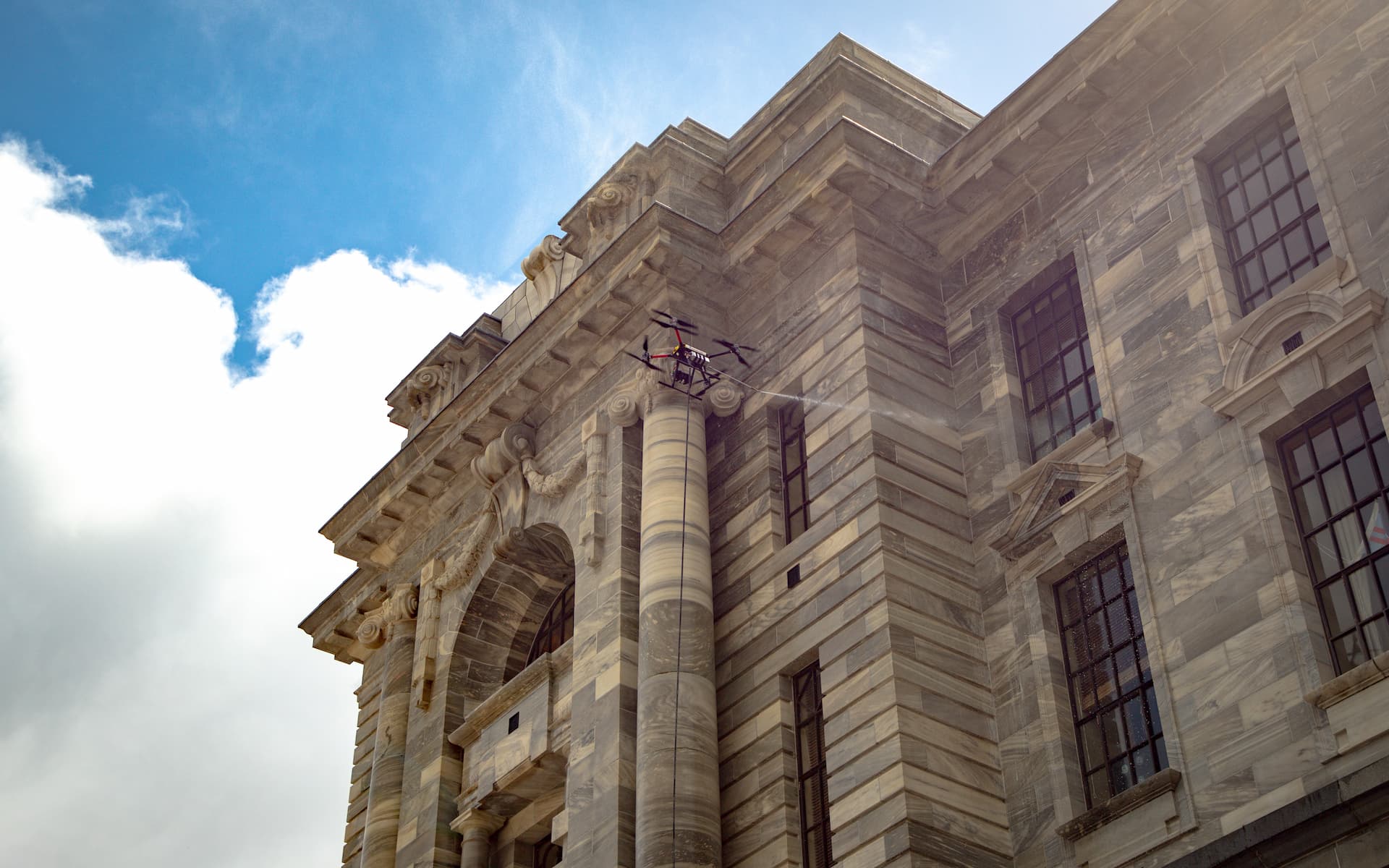
An experienced commercial roofing contractor should conduct a thorough roof survey before any decisions are made. This may include drone inspections, thermal imaging (to detect moisture trapped within the roof assembly), structural integrity checks, and assessment of guttering, flashings, and penetrations. At Edwards & Hardy, our drone inspection service can provide detailed roof imagery across even the largest commercial buildings safely and efficiently.
2. Define the Scope
Based on the assessment, your contractor should provide a clear written scope of works. This includes: what's being removed, what's being retained, what new materials are being installed, how penetrations and flashings will be handled, and what the edge protection and health and safety plan is. For buildings with asbestos-containing roof materials (a common issue on pre-1990 commercial buildings), the scope must include licensed asbestos removal by a certified Class A or B removalist.
3. Consents and Compliance
Most commercial re-roofing projects require a building consent under the New Zealand Building Act, particularly where structural changes are involved or where the existing roof structure requires remediation. Your contractor should identify consent requirements early. Work must be performed by LBP (Licensed Building Practitioner) holders and may require producer statements and a code compliance certificate at completion.
4. Planning for Business Continuity
This is where commercial re-roofing differs most from residential work. Your project plan must account for:
- Staging the works — Phasing re-roofing in sections allows parts of the building to remain operational while others are under construction.
- Temporary weatherproofing — High-quality temporary sheeting over exposed sections protects the building between the removal of old roofing and installation of new.
- Noise and dust management — Particularly in occupied buildings such as schools, healthcare facilities, or offices.
- Access and crane/equipment planning — Large roof sections, material handling, and waste disposal on commercial sites require careful logistics coordination.
5. Health and Safety
Commercial roofing is classified as working at height under the Health and Safety at Work Act 2015 (HSWA NZ). A site-specific Health & Safety Plan is required, covering edge protection (scaffolding, guardrails, or safety nets), fall arrest systems, emergency procedures, and subcontractor management. Edwards & Hardy holds SafePlus accreditation and operates to the highest H&S standards across all commercial projects.
6. Quality Control and Handover
A reputable contractor will provide a completion inspection, photographic records of the completed work, manufacturer warranties on materials, and a workmanship guarantee. Ensure you receive all documentation — you'll need it for insurance purposes, building compliance, and future due diligence.
How Long Does a Commercial Re-Roof Take?
This depends enormously on building size, complexity, materials specified, and staging requirements. A straightforward warehouse re-roof of 3,000m² might take two to three weeks. A staged re-roof of a school incorporating asbestos removal, multiple roof sections, and term-time work restrictions might take several months of planning and phased execution over a school holiday period.
How Much Does Commercial Re-Roofing Cost in NZ?
Commercial roofing is priced differently from residential work, typically on a per-square-metre basis with additional allowances for access, complexity, and compliance. As a broad indicative range, commercial long-run steel re-roofing in NZ currently runs from approximately $80–$180+ per m² fully installed depending on the factors above. Large projects benefit from economies of scale; complex or multi-storey projects attract premiums.
The only reliable way to price a commercial re-roof is through a detailed site-specific assessment and written tender. Contact Edwards & Hardy for a commercial assessment.
Why Choose Edwards & Hardy for Commercial Re-Roofing?
Edwards & Hardy is one of New Zealand's most experienced and awarded commercial roofing contractors. We were named RANZ Commercial Roofer of the Year 2024 — recognition of our commitment to quality, safety, and professionalism on commercial projects. Our portfolio includes warehouses, schools, wool stores, civic buildings, healthcare facilities, and multi-building campuses across the country.
We bring the experience, licensing, equipment, and people to deliver your project on time, in budget, and to the highest standard. Talk to our commercial team today.